

Written by Jean-Georges NANOT, May 13, 2026
Table of contents
- The 2026 geopolitical risk landscape for foreign companies in France
- What standard insurance policies cover and exclude
- Building specialized coverage: PVT, TDI, K&R
- Crisis governance and broker coordination
- Conclusion: geopolitics is now a permanent boardroom topic
- Real-world case: a French subsidiary facing the Red Sea disruption
- Frequently asked questions
Introduction
According to the 2026 edition of the Allianz Risk Barometer, “political events and violence” entered for the first time the top 5 most-feared risks for European corporate leaders, behind cyber, business interruption, climate risks, and regulatory evolution. For foreign-headquartered groups operating French subsidiaries, geopolitical risk is no longer an abstract concern at HQ level: it directly affects French entity contracts, assets, and employees.
The insurance market for war and geopolitical risks has been transformed in the last five years. Standard policies have hardened their war exclusion. Specialized policies (PVT, TDI, K&R) have refined their conditions. The OFAC sanctions clause is now omnipresent and affects French subsidiaries trading internationally. CBE Consulting advises foreign-headquartered groups on mapping geopolitical exposure for their French operations and structuring adapted coverage. This article describes the 2026 landscape, the available coverages, and operational governance.
1. The 2026 geopolitical risk landscape for foreign companies in France
Active conflict theaters
Four main theaters structure 2026 geopolitical risk for European-based operations:
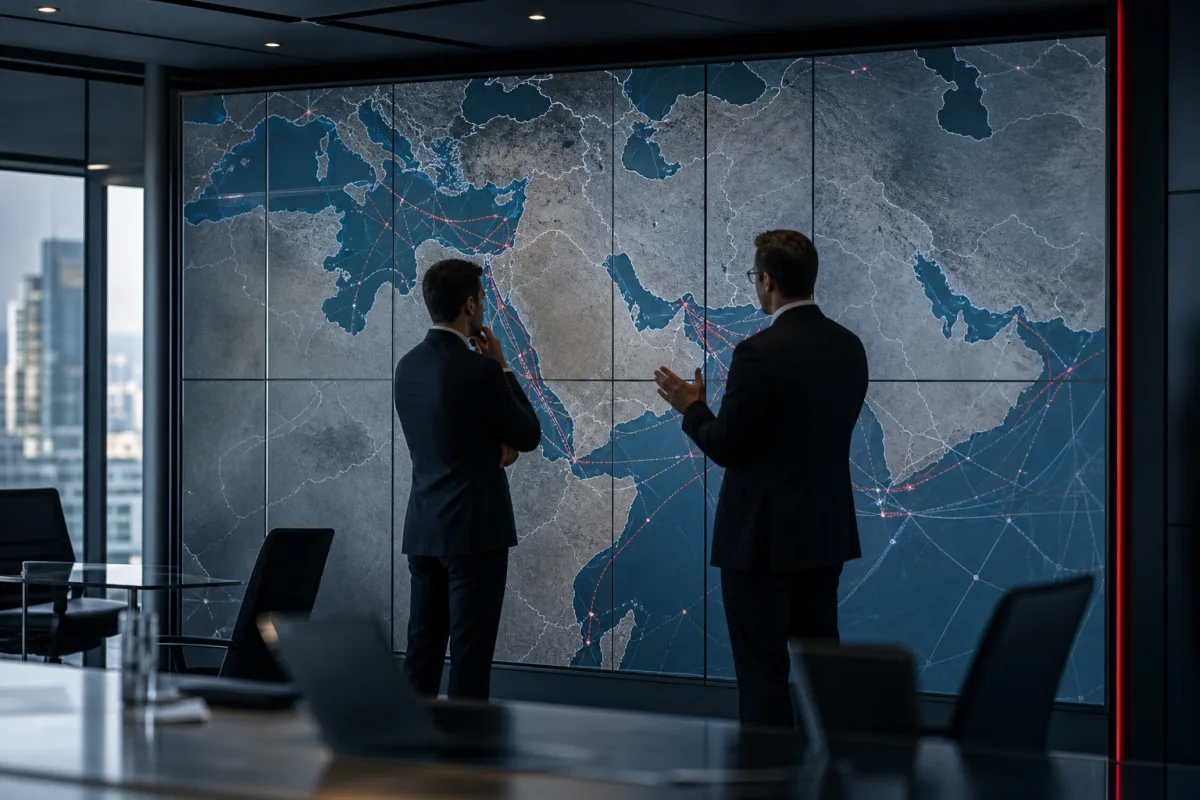
- Middle East theater: active conflicts in Israel/Gaza, Lebanon instability, Iran-Saudi tensions, Houthis attacks on Red Sea shipping (ongoing since late 2023), Syria/Iraq instability
- Eastern Europe theater: active Russo-Ukrainian conflict, increased tensions on Baltic states and Poland, consolidated EU sanctions
- Sahel and Africa theater: French military withdrawal, jihadist insurgency rise, chronic instability in Mali, Burkina Faso, Niger, Sudan
- Asia-Pacific theater: Taiwan tensions, South China Sea, Korean Peninsula, increased US extraterritorial sanctions
For foreign-headquartered groups, the question is not whether French operations are exposed, but how. Most French subsidiaries import materials from Asia (transiting via the Red Sea), have customers in sanctioned regions, or send employees to risk zones.
Indirect consequences for French subsidiaries
Even without direct presence in conflict zones, French subsidiaries face indirect consequences:
- Energy price volatility: oil, gas, electricity. A French industrial subsidiary saw energy costs vary 30-80% between 2021 and 2023
- Supply chain ruptures: logistical blockages (Red Sea), sanctions affecting critical suppliers (semiconductors, rare earths), raw material shortages
- Currency volatility: local depreciation of certain currencies, fund blocking risks, exchange controls
- State-attributed cyber risk: cyber attacks attributed to state actors create a new interaction with the war exclusion of cyber policies
- Reputation and boycott risk: societal pressure on companies maintaining activity in certain sensitive geographies
Mapping these indirect consequences is as important as mapping direct exposure: a Tier 2 supplier in a risk zone can paralyze a French production line without direct French operations.
The war exclusion in 2026
Three transformations of standard war exclusions since 2020:
- Standard coverage restriction: war exclusion has hardened in PD, GL, transport, and cyber policies. Attacks attributed to states, declared or undeclared war, armed conflicts are systematically excluded
- Dedicated specialized policies: PVT (Political Violence Terrorism), TDI (Trade Disruption Insurance), CONFISC (confiscation, nationalization, expropriation) policies have refined their conditions
- Omnipresent sanctions clause: all policies now include a clause excluding payment to a beneficiary appearing on a sanctions list (OFAC SDN List, EU sanctions, UN). This applies to indemnifications and ransom payments
2. What standard insurance policies cover and exclude
Standard war exclusion
All standard insurance policies (PD, GL, transport, cyber) include war exclusions. Three main families:
- War exclusion: excludes damage resulting from a declared or undeclared state of war, invasion, civil war, revolution, insurrection, military power
- Terrorism exclusion: excludes damage resulting from terrorist acts. Some policies buy back this exclusion in France via GAREAT, with limited capacity
- NCBR exclusion: excludes damage resulting from nuclear, chemical, biological, radiological events. Universal and not buyable
For French subsidiaries of foreign groups, the implication is that the global group policy’s war exclusion applies to French risks. The French entity faces the same exclusions that would apply at HQ level.
War risk insurance market
Three centers offer war risk coverage:
- London market (Lloyd’s): historical world center for war risks, particularly active on maritime, aviation, and assets in risk zones. The Joint War Committee publishes an updated Hull Listed Areas war zone list
- Specialized European insurers: Zurich, AXA XL, AIG, Munich Re, Allianz offer PVT, TDI, K&R, expropriation coverage
- Government bureaus (BPI Assurance Export in France, equivalents UK Export Finance, US Exim Bank) cover certain political risks on export contracts
War risk premiums vary significantly by zone and asset type: * Maritime transport via Red Sea: war risk surpremium of 0.5 to 2% of cargo value * Real estate in moderate risk zones (Lebanon outside South, certain West African countries): 1 to 3% of insured value per year * Assets in high-risk zones (Ukraine, Yemen, Sudan): 5 to 15% or coverage refusal
Sanctions and embargoes: effect on existing contracts
International sanctions (EU, OFAC, UN) directly affect existing insurance contracts. Three mechanisms:
- Sanctions clause: present in all modern contracts, suspends insurer obligations on sanctions violations. If a claim concerns a sanctioned operation, the insurer can refuse indemnification
- Limited retroactive effect: contracts issued before new sanctions can remain operative under conditions, but renewal will integrate new sanctions
- Director criminal risk: maintaining a sanctioned activity exposes the directors personally to criminal sanctions. D&O insurance generally does not cover personal criminal fines
3. Building specialized coverage: PVT, TDI, K&R
Political Violence Terrorism (PVT) policies
The PVT policy covers damage to assets and business interruption losses resulting from political violence: terrorism, sabotage, riots, civil disturbances, mutiny, coup d’état, declared or undeclared war. It complements or replaces French GAREAT for international group exposures.
Typical characteristics: * Limits of EUR 1-50M depending on company size * Deductibles of EUR 25,000-250,000 * Geographic perimeter specified (list of covered, excluded, or surcharged countries) * Business interruption period: 12-24 months * Annual cost: 0.2-2% of insured asset value depending on zone
For foreign-headquartered groups with French operations exposed to certain risk geographies (Maghreb, West Africa outside jihadist zones, certain Latin American countries, Caucasus), PVT has become a standard.
Trade Disruption Insurance (TDI)
The TDI covers financial losses resulting from international supply chain interruption due to a political or violence event. It triggers notably:
- When a port is blocked by a geopolitical crisis (Red Sea case 2024-2026)
- When a border is closed for political reasons
- When a zone is declared non-navigable by the Lloyd’s Joint War Committee
- When a key supplier is paralyzed by a major political event
TDI covers logistical extra costs (rerouting, urgencies) and business interruption losses linked to delay or impossibility to deliver. It is an emerging coverage, still little known by French subsidiaries of foreign groups, but its relevance was demonstrated by the Red Sea crisis. Typical cost: EUR 50,000-150,000/year for limits of EUR 1-3M on a mid-cap exporter.
Kidnap & Ransom (K&R) and personal security
For employees sent to sensitive zones from the French subsidiary, Kidnap & Ransom coverage is essential. It covers abduction, extortion, hostage-taking, emergency evacuation. A serious K&R policy includes a retainer with a security responder (Control Risks, NYA, Constellis) that takes over in case of incident.
Our dedicated article on K&R insurance for foreign companies details costs, exclusions, and operational mechanics in the French legal framework.
Free assessment of your French subsidiary’s geopolitical exposure
Does your French subsidiary import from Asia via the Red Sea, have customers or suppliers in risk zones, or send employees abroad? CBE Consulting offers a free assessment of geopolitical exposure. 30 minutes by video, no commitment.
Request an assessment → · +33 9 80 43 16 34 · secretariat@cbeconsulting.fr
4. Crisis governance and broker coordination
Business continuity planning
Any geopolitical insurance coverage requires a documented business continuity plan (BCP). The BCP lists critical processes, identifies alternate sites and suppliers, formalizes evacuation procedures, anticipates degraded operating modes.
Without BCP, PVT or TDI insurance covers the loss financially but does not prevent prolonged operational shutdown. The BCP is the prevention tool that also reduces the policy’s time deductible.
Mature groups integrate their BCP into ISO 22301 certification.
Crisis cell coordination with brokers
In case of active geopolitical crisis (conflict outbreak, sudden sanctions, major attack), the internal crisis cell (CEO, CFO, legal, communications, HR, security) must rely on the consulting broker in real time. Three engagements to formalize in the brokerage mandate:
- 24/7 availability of broker contact for geopolitical crises
- Immediate activation of specialized policies (PVT, TDI, K&R) with mobilization of providers (security responder, expert adjuster, negotiator)
- Coordination with authorities: Quai d’Orsay (French foreign ministry), embassies, local authorities, French authorities
The consulting broker acts as the operational arm of the crisis cell on insurance and security matters.
Group reporting in crisis time
During prolonged crisis (like the Red Sea crisis or Ukrainian conflict), specific reporting is set up:
- Weekly or bi-weekly review depending on intensity
- Tracking of ongoing claims and expected indemnifications
- Geopolitical watch (modified risk zones, new sanctions)
- Coverage adaptation (extensions, temporary exclusions)
- Coordination with local subsidiaries
This reporting feeds directly into board and executive committee decisions. Geopolitical crisis management has become a permanent boardroom topic for foreign-headquartered groups with European operations.
5. Conclusion: geopolitics is now a permanent boardroom topic
The 2026 geopolitical context is no longer a stable environment interrupted by punctual crises. It is now an environment of overlapping permanent crises: Middle East, Ukraine, Sahel, Asia-Pacific tensions. For foreign-headquartered groups with French operations, geopolitical risk has entered the top 5 major risks and will remain there durably.
The adapted insurance coverage combines standard reinforced policies, PVT, TDI, K&R, and a crisis governance dispositive to transform financial coverage into operational resilience. To engage a personalized assessment of your French subsidiary’s geopolitical exposure, contact CBE Consulting via the contact page.
6. Real-world case: a French subsidiary facing the Red Sea disruption
Context: a Japanese consumer electronics group operates a French subsidiary (revenue EUR 145M, distribution Europe). Sourcing: 70% from Asia (Japan, China, Korea), transit primarily via Suez. Red Sea crisis from late 2023.
Operational impact in 2024: * Delivery delays: 10-14 days extra transit * Freight extra costs: war risk surpremium + Cape of Good Hope detour, total EUR 180,000 * Customer contractual penalties: EUR 95,000 over 8 months * Buffer stock build-up: cash flow impact EUR 280,000 * Loss of distribution agreement (retailer dropped product line due to supply unreliability): EUR 1.1M loss * Total direct impact: EUR 1.655M
Coverage mobilized: * Standard PD policy with transport extension: did not cover logistical extra costs linked to war situation (war exclusion) * No TDI subscribed before 2024: zero indemnification on delays and extra costs * Marine cargo policy with war risk insurance via Lloyd’s: covered cargo damage only (zero material claim), not business interruption
Uncovered loss: EUR 1.655M
Restructuring in early 2025: * TDI subscription with a Lloyd’s syndicate, limit EUR 1.5M over 12 months, annual premium EUR 95,000 * Buffer stock increase on 8 critical references (permanent cash flow impact EUR 600,000) * Sourcing diversification: addition of Morocco and Poland suppliers to reduce Asia dependency
2025 outcome: Red Sea crisis prolonged. Extra costs limited to EUR 1.1M (-33%), of which EUR 600K indemnified via TDI. Net loss: EUR 500K vs. EUR 1.655M previous year. ROI of restructuring: EUR 1.155M net savings over 12 months.
Case profile constructed from 2024-2025 publications on the Red Sea crisis and AMRAE feedback.
Have CBE Consulting assess your French subsidiary’s geopolitical exposure
Our consultants offer:
- A free assessment of your geopolitical exposure by geography, subsidiary, flow, and employees
- A review of your standard policies against 2026 scenarios
- A costed recommendation for blind spot coverage (PVT, TDI, K&R, CONFISC)
No commitment, by video, 30 minutes.
Phone: +33 9 80 43 16 34 Email: secretariat@cbeconsulting.fr
7. Frequently asked questions
Does a standard insurance policy cover war consequences? No, in most cases. All standard policies (PD, GL, transport, cyber) include a war exclusion that excludes damage from declared or undeclared war, invasion, civil war, revolution, insurrection. War risk coverage requires specific policies: PVT (Political Violence Terrorism), TDI (Trade Disruption Insurance), K&R (Kidnap & Ransom), CONFISC for confiscation and expropriation.
What’s the difference between PVT and TDI? PVT covers damage to assets and local business interruption from political violence: terrorism, sabotage, riots, coup d’état. It protects physical assets. TDI covers financial losses from international supply chain interruption due to a political event: port blockage, border closure, non-navigable zone. It protects flows. Both are complementary for an exporter or importer with significant cross-border activity.
How much does war risk insurance cost for a French subsidiary? The cost varies strongly by zone and asset type. For an SME or mid-cap: maritime transport via Red Sea with 0.5-2% war risk surpremium of cargo value; real estate assets in moderate risk zones (1-3% of insured value per year); assets in high-risk zones (5-15% or coverage refusal). For complete PVT on 1-3 sites in moderate zones, EUR 25,000-80,000/year for a mid-cap. For TDI, EUR 50,000-150,000 depending on flows and limits.
What is the OFAC sanctions clause and how to avoid it? The sanctions clause is present in all modern insurance policies. It suspends insurer obligations in case of international sanctions violation (OFAC SDN List, EU sanctions, UN). Concretely: if a claim concerns an operation with a sanctioned entity, the insurer can refuse indemnification. If a ransom payment must go to a sanctioned beneficiary, payment is illegal and not covered. To avoid: systematic verification of counterparties vs. sanctions lists, international compliance program, continuous monitoring of sanctions evolutions.
Are my Russian subsidiaries still insurable? Coverage of Russian assets and operations has become very restricted since 2022. European and North American insurers have massively reduced or ceased their appetite for this market. Residual coverage passes mainly through local Russian insurers (with capacity limitations and major political exclusions) or through the London market with very restrictive conditions. For foreign-headquartered groups with residual Russian presence, the typical strategy is self-financing routine claims with London market transfer only for catastrophic claims.
How to cover the geopolitical risk of exports to a sensitive country? Three complementary mechanisms. First, export credit insurance covers commercial and political risk on receivables: Coface for state guarantees, Allianz Trade or Atradius for private. Second, TDI can cover business interruption in case of political logistical blockage. Third, for high-value contracts, CONFISC policies or Cap Francexport coverage can secure advances and on-site assets.
About the author: Jean-Georges NANOT
Jean-Georges NANOT is consulting broker and founder of CBE Consulting, an insurance broking firm based in France specialized in international risk management. He advises French ETIs with international activity and foreign-headquartered subsidiaries in France on insurance program structuring, risk audits, and claims management.
ORIAS no. 15000172 LinkedIn: [to be completed] View all articles by this author
About this article
This article was written by Jean-Georges NANOT to provide expert insight on the topic discussed. The information presented is of a general nature and does not replace a personalized audit. Each situation requires specific analysis of your risk exposure. For an assessment adapted to your company, contact our team.
This article is updated quarterly to track geopolitical evolution. Last update: May 13, 2026.
CBE Consulting, Cap de Bonne-Espérance Consulting, insurance broker. ORIAS no. 15000172 Supervisory authority: ACPR, 4 place de Budapest, 75009 Paris, France.
Sources and references
- Allianz Risk Barometer, annual edition
- Lloyd’s Joint War Committee, Hull Listed Areas
- France Diplomatie, Quai d’Orsay travel advice
- OFAC SDN List and EU sanctions
- GAREAT, French terrorism reinsurance pool
- AMRAE annual risk management barometer
- Marsh Political Risk Map
- Aon Political Risk Annual Report
Featured Industries
Become an Expert!
Get the latest insights from our newsletter.
Free 31 page Blueprint For Consultants
Complex situation, changing demands and dynamic market environment make today's business even more challenging.